Which projects has CrowdHive announced?
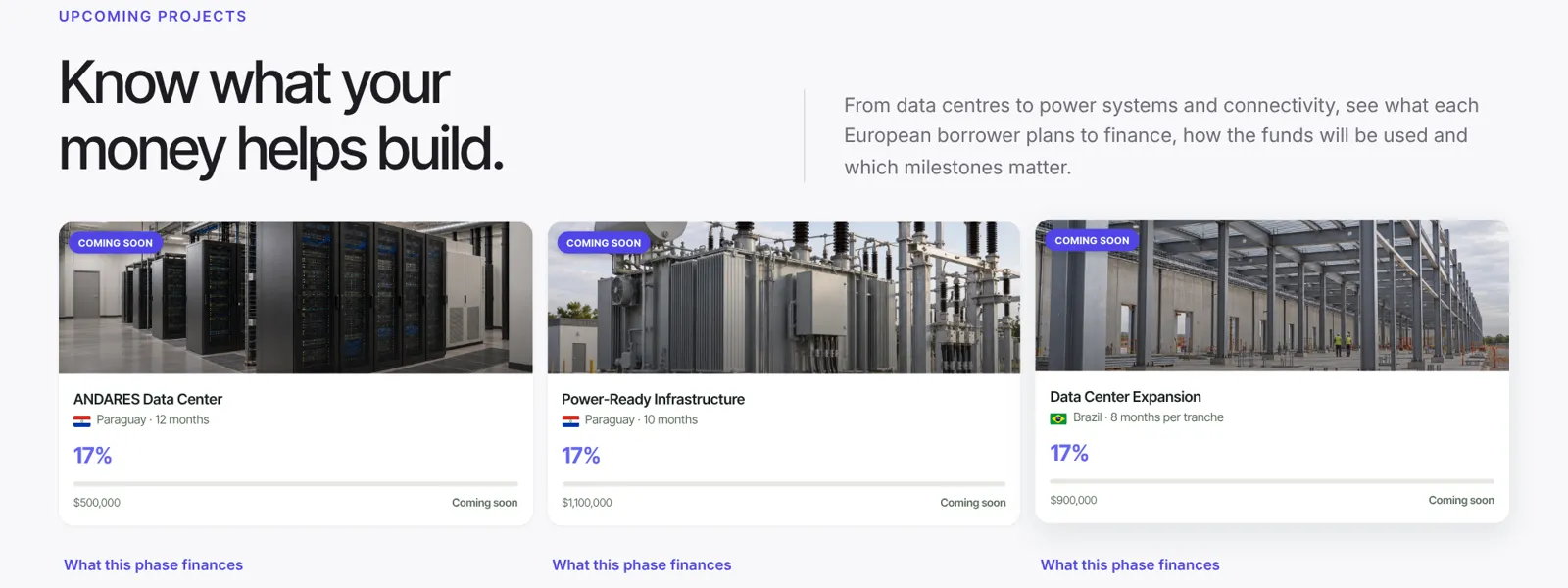
CrowdHive projects announced so far are four loans worth $4 million in total, all at 17% a year and all marked “coming soon”. Two are in Paraguay, one is in Brazil and one is in Mexico. Three finance data-centre and power sites, and one goes to a lending business. Borrower names, collateral and ratings have not been published yet.
CrowdHive projects are business loans for digital infrastructure in Latin America, and four have been announced. None is open for investment yet: every card on the website says “coming soon”1. What follows is what the cards and the General Terms tell us, project by project.
Which projects has CrowdHive announced?
Four loans with a combined size of $4 million. All pay 17% a year and run for 8 to 12 months.
CrowdHive describes its borrowers as European companies that manage infrastructure projects in Latin America. It also says each project’s documents will separate the borrower’s registration, the operating company, the site and the law that governs any security2. That matters, because the company that owes you money and the place where the collateral sits can be in different countries.
ANDARES data centre, Paraguay
$500,000 for 12 months at 17%. The loan finances the first, 500 kW phase of a modular data centre in Paraguay. The card says AI and GPU equipment is planned for a later phase, so this loan does not pay for it.
500 kW is a small site. That makes this the most straightforward of the four: one phase, one site, one year.
Power-Ready Infrastructure, Paraguay
$1.1 million for 10 months at 17%. The money goes into a 6 MW site in Alto Paraná, built for data centres and “energy-intensive computing, including mining”. The card does not say what kind of mining. Alto Paraná is home to the Itaipú hydroelectric dam, which supplies cheap power. In Paraguay, sites like this are often used for cryptocurrency mining. That is our context, not a claim from CrowdHive.
Data Center Expansion, Brazil
$900,000 at 17%, with a term of 8 months per tranche. It finances the construction and fit-out of a 1 MW data hall, including infrastructure for high-density GPU systems.
“Per tranche” means the loan is paid out in parts, each with its own 8-month clock. The card does not yet say how many tranches there are or when each one starts. That affects how long your money is actually committed.
Digital Lending, Mexico
$1.5 million at 17%, 10 months per tranche. This is the odd one out. The borrower is described as a Singapore-based fintech, and CrowdHive lists the project under “other business lending”, outside its infrastructure focus.
One question comes up here. The General Terms bar borrowers from using the platform for “interest-differential business”, meaning borrowing money to lend it on at a higher rate3. A lending company borrowing at 17% looks close to that. This is the loan whose documents we will read first at launch.
The loan is also the largest. At $1.5 million it is above CHF 1 million at any recent exchange rate. Under the General Terms, a project of that size needs the company’s prior authorisation and must meet any extra regulatory requirements.
What is still missing before you could judge a project?
The basics of credit analysis. The borrowers’ names, their accounts, the collateral and the risk grades are all listed as “to be confirmed”1. Under the General Terms, borrower information is shared with investors only with the borrower’s approval. The scope of what gets published is agreed project by project3.
The General Terms list what CrowdHive itself checks: the borrower’s history and track record, its solvency, its management and owners, the project’s viability, the collateral, the business plan and the sector risks. You will not see that review in full. The checklist below lists what each card should show when it opens. For power and data-centre sites, also look for contracted capacity, the length of the power tariff, grid connection agreements, permits and backup systems: that is the checklist CrowdHive itself suggests.
When the first project opens, we will add its documents to this page and mark which of these points are covered. Until then, the rates and amounts above are announcements, not offers.
Before you fund a CrowdHive project
Seven things to find on the project card. Tick them off as you check; your ticks stay in this browser.
All seven found. If any answer was missing, wait for the next project.
How do the projects compare with the platform’s own figures?
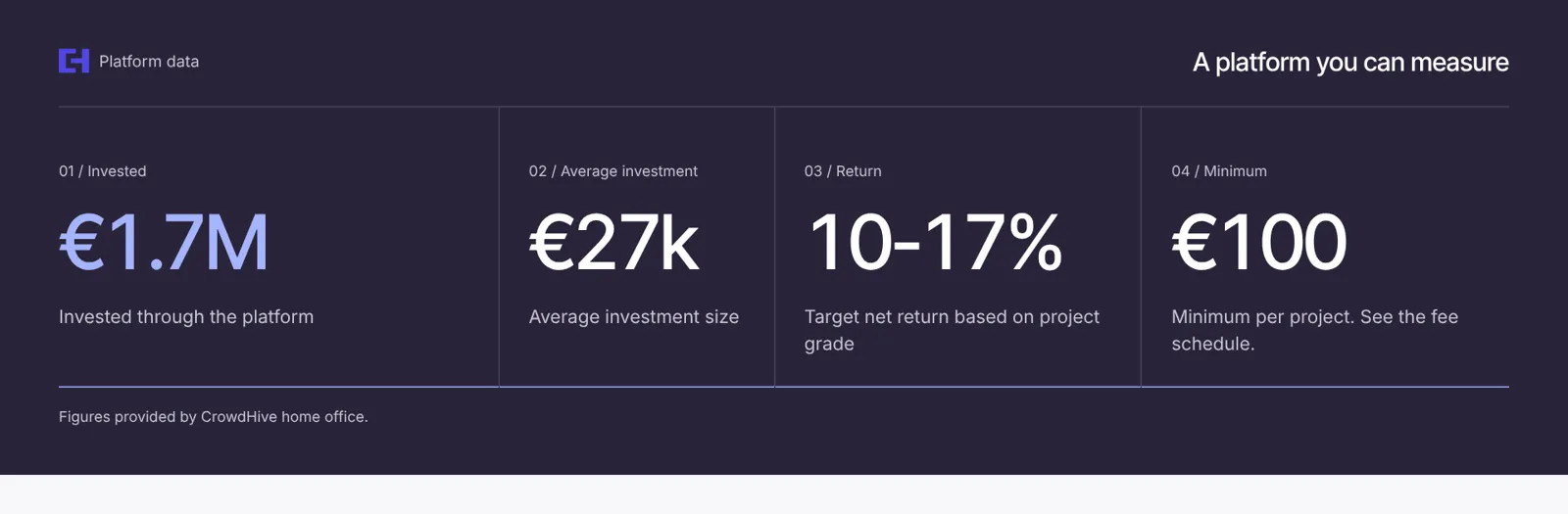
They are larger than anything the platform has reported. The homepage shows €1.7 million invested and an average investment of €27,000, labelled as “figures provided by CrowdHive home office”1. No project has opened on the platform yet, so these figures cannot come from it. Treat them as marketing until the Statistics page shows them loan by loan.
The website’s example screens also show other projects, such as solar, logistics and a port terminal, with rates from 10% to 17%. They are labelled as illustrations, not live offers, so we leave them out.
When will the projects open?
No date has been published. Access opens to people on the waitlist after a notification.
Can I choose a single project?
Yes. You invest per project, from €100 each, or set Auto-Invest rules to spread money across projects.
What happens if a project does not reach its target?
The investment does not become binding and your money returns to your available balance, usually after an offer period of 30 days.